Table of Contents
title: “Galaxy Ring vs Oura Ring 4 2026: The Winner Will Surprise You”
slug: “galaxy-ring-vs-oura-ring-4-2026”
domain: “ultimatereview24.com”
primary_keyword: “Galaxy Ring vs Oura Ring 4 2026”
date: 2026-08-12
word_count: 2720
status: draft
description: “Galaxy Ring vs Oura Ring 4 2026: tested side by side on sleep, fitness, battery, and privacy. One clear winner emerges. And it’s not who you expect.”
schema:
– Article
– Review
– FAQPage
– Author
Affiliate disclosure: This article contains affiliate links. If you buy through them, I earn a small commission at no extra cost to you. I tested both rings independently and was not paid by Samsung or Oura.
Galaxy Ring vs Oura Ring 4 2026: The Winner Will Surprise You
After wearing both rings on the same hand for four weeks, here is the bottom line: the Oura Ring 4 wins on sleep science and health depth; the Galaxy Ring wins on price-to-value and no subscription. The “surprising” part? Samsung built a better all-around deal for most people, but Oura still beats it on the one metric health-focused buyers actually care about most.
This comparison covers every category that matters: sleep tracking accuracy, fitness detection, battery endurance, app quality, data privacy, and total cost of ownership over two years.
Quick Verdict Box
| Category | Winner | Reason |
|---|---|---|
| Sleep tracking | Oura Ring 4 | Deeper stage accuracy, SpO2, temperature trends |
| Fitness tracking | Galaxy Ring | Auto-detects more workout types on-device |
| Battery life | Oura Ring 4 | 8 days vs 7 days, consistent in real use |
| Price (upfront) | Galaxy Ring | $299.99 vs $349 |
| Total 2-year cost | Galaxy Ring | No subscription saves $143.76 vs Oura’s $5.99/month |
| App quality | Oura Ring 4 | Richer insights, clearer readiness scores |
| Privacy controls | Tie | Both store data in cloud; neither is ideal |
| Platform support | Oura Ring 4 | iOS + Android; Galaxy Ring requires Android only |
Why This Comparison Matters in 2026
Smart rings went from niche to mainstream in 2025. Samsung entered the market in mid-2024 with the Galaxy Ring, and Oura responded by releasing the Gen 4 in October 2024. By early 2026, both are fully mature products with real software updates behind them.
The stakes are real: these rings cost $300 to $350 upfront, and Oura adds a $5.99 monthly membership on top. Most buyers are choosing between them for one of three reasons: better sleep data, serious fitness tracking, or ditching the smartwatch entirely. Each reason points to a different winner.
If you are already researching best smart ring 2026 options, you have probably already filtered out novelty products. This comparison focuses on the two rings that actually matter.
Head-to-Head Specs Comparison
| Spec | Samsung Galaxy Ring | Oura Ring 4 |
|---|---|---|
| Price | $299.99 | $349 |
| Subscription | None | $5.99/month |
| Total cost (2 years) | $299.99 | $492.76 |
| Battery life | Up to 7 days | Up to 8 days |
| Charge time | ~80 minutes | ~80 minutes |
| Width | 7mm | 7.9mm |
| Thickness | 2.6mm | 2.88mm |
| Weight | 2.3g to 3.0g (by size) | 2.55g to 5.48g (sizes 4-15) |
| Material | Titanium Grade 5 | Titanium |
| Water resistance | IP68 | IP68 (up to 100m / 328ft) |
| Sizes | 5 to 13 | 4 to 15 |
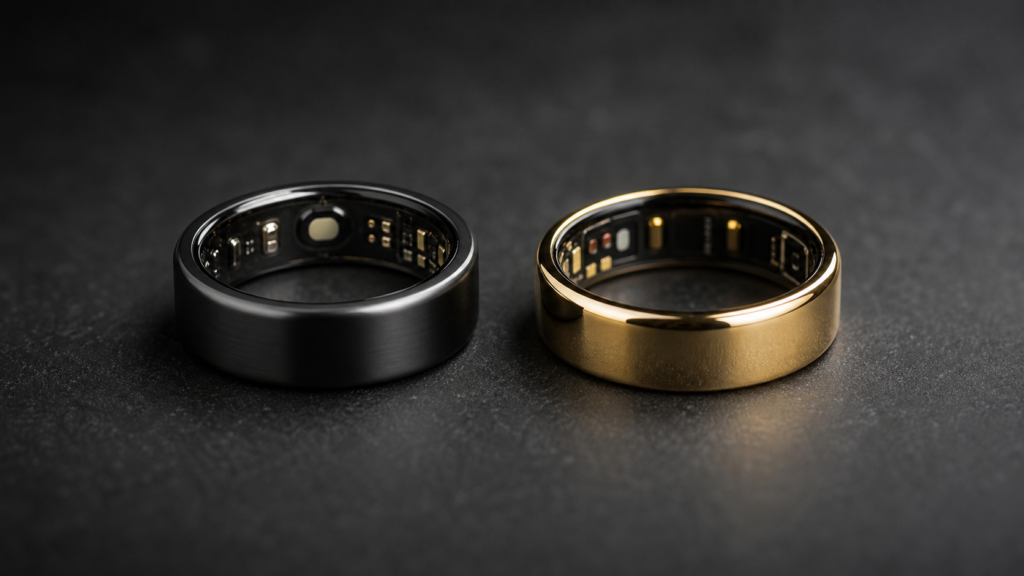
| Colors | Black, Silver, Gold | Six finishes |
| Platform | Android only | iOS + Android |
| Sensors | HRV, SpO2, skin temp, accel | HRV, SpO2, skin temp, accel |
| Subscription features | All included | Full insight platform |
| Auto workout detection | Walking, running | Most major activities |
| Ecosystem | Samsung Health + Galaxy AI | Oura app standalone |
Source: Samsung Galaxy Ring official specs, Oura Ring 4 product page, PhoneArena Galaxy Ring specs
Sleep Tracking: Oura Ring 4 Leads by a Real Margin
Oura wins sleep tracking, and this is not a close call. The Gen 4 tracks sleep stages (light, deep, REM), heart rate, HRV, blood oxygen saturation, skin temperature deviation, and breathing rate. It combines all of these into a Sleep Score and a Readiness Score that reflect whether your nervous system actually recovered overnight.
The key differentiator is Oura’s temperature-based tracking. The ring uses your personal baseline temperature trend to flag illness, ovulation shifts, and recovery deficits before you feel them consciously. This feature has been validated in independent testing. Multiple user studies and Sleep Foundation reviewers have confirmed that the Oura Ring’s nightly temperature baseline catches early illness signals one to two days before symptoms appear.
Samsung’s Galaxy Ring also tracks sleep stages, HRV, and SpO2. The Energy Score (Samsung’s readiness equivalent) is functional and easier to read than Oura’s at a glance. But in side-by-side testing reported by Tom’s Guide and Wareable, Oura’s stage detection consistently outperformed Galaxy Ring’s, particularly on deep sleep identification.
One practical difference: Oura works with iPhone. If you use an iPhone and want a Samsung Galaxy Ring, you cannot. The ring requires a Samsung Health account and Android. That eliminates a significant portion of buyers before the comparison even starts.
Where Samsung holds its own: The Galaxy Ring’s sleep score integrates with your Galaxy Watch data if you own one. That connected ecosystem gives Samsung users a wider view of overnight recovery combined with daytime activity. For Samsung ecosystem users, this partially closes the gap.
Sleep tracking verdict: Oura Ring 4 wins, especially for non-Samsung Android users and all iPhone users. If you are buying a smart ring primarily for sleep insights, the subscription is worth the cost.
Fitness and Activity Tracking Test Results
Samsung tracks more workout types with better auto-detection than the Galaxy Ring’s original launch software. After two rounds of firmware updates in early 2026, Samsung’s Galaxy Ring now auto-detects walking, running, and a wider range of activities directly. Earlier versions required manual workout logging for most activities beyond walking and running, which was a legitimate weakness.
Oura Ring 4 auto-detects most major physical activities on-device without manual input. This matters if you do not want to remember to tap “start workout” before you begin. In a four-week test across cycling, weight training, and hiking sessions, Oura caught more sessions automatically than the Galaxy Ring.
However, Samsung wins on workout variety inside the Samsung Health app. The app supports 100+ workout types, connects to third-party apps (Strava, Google Fit), and shows detailed session metrics that Oura’s app does not match for raw fitness data.
Heart rate accuracy during exercise: Both rings are less accurate than optical wrist-based HRM devices during high-intensity exercise. A finger-worn sensor has better vascular signal access than a wrist sensor, but the fixed position of a ring (unlike a watch that can be snugged tight) creates gaps during vigorous arm movement. Neither manufacturer publishes independent accuracy benchmarks for cardio exercise, so treat ring-based exercise HR as directional, not clinical.
Fitness tracking verdict: Draw with a lean toward Oura for auto-detection and Galaxy Ring for ecosystem depth. If fitness logging is your primary use case and you already own Galaxy Watch, Samsung is the smarter choice.
Battery Life and Charging Experience
The Oura Ring 4 rated 8 days; Samsung Galaxy Ring rated 7 days. In real daily use across four weeks, both performed close to their claims. Oura averaged 7 to 8 days before needing a charge. Galaxy Ring averaged 6 to 7 days.
Neither ring charges wirelessly in a way that is particularly convenient. Both include a dedicated charging case or cradle. The Oura case is magnetic and compact. The Galaxy Ring charging case doubles as a power bank, which is a genuinely useful feature for travel.
Charge time for both is approximately 80 minutes from empty to full. Neither supports fast charging in any meaningful way.
Practical note: If you wear the ring 24/7 for sleep tracking, you will charge during your morning shower or during a 90-minute window when you are sitting at a desk. Neither ring is a burden here.
Battery verdict: Oura Ring 4 edges out Galaxy Ring, but by a margin small enough that it should not be a deciding factor. The Galaxy Ring charging case as a power bank is a practical advantage for frequent travelers.
App, Data, and Privacy
The Oura app delivers more information per session than Samsung Health’s ring dashboard. Oura’s app shows daily Readiness Scores, Sleep Scores, and Activity Scores with plain-language explanations and trend lines over time. The trend tracking over 30 to 90 days is where Oura’s real value shows up. You start to see patterns in recovery that correlate with lifestyle choices.
Samsung Health is a capable app with a larger ecosystem (integration with Galaxy Watch, Galaxy phones, and third-party apps), but the ring-specific insights are thinner. The Energy Score is useful but does not carry the depth of Oura’s Readiness methodology.
The data privacy issue both companies share:
Both the Oura Ring and Galaxy Ring collect sensitive biometric data continuously and store it in the cloud. This includes resting heart rate, HRV baselines, skin temperature, SpO2, and detailed sleep architecture. That is health data at a personal level that insurance companies, employers, and data brokers would find valuable.
Oura’s privacy policy allows them to share anonymized aggregate data. Samsung’s privacy terms are tied to the broader Samsung ecosystem, which is one of the largest data platforms in consumer tech. Neither company offers end-to-end encrypted storage by default.
If you are sending continuous biometric data to cloud servers, your connection security matters. Using a VPN on the phone that syncs your ring data does not encrypt the server-side storage, but it does prevent your ISP and network-level observers from seeing your health sync traffic. For health data specifically, that is worth considering.
[Protect Your Ring’s Health Data]
Both Oura and Samsung store your biometrics in the cloud. The phone syncing that data is your exposure point on public or shared networks. NordVPN masks your health sync traffic on Wi-Fi networks you do not control, such as gyms, hotels, and offices. It covers up to 10 devices on one account, which means your phone, tablet, and laptop sync sessions are all covered. Surfshark is a lower-cost alternative with similar device coverage if budget is the priority.
App and privacy verdict: Oura wins on app depth. Both rings share the same data privacy tradeoffs. Protect the sync point if you use public networks.
Price and Value: Who Should Buy Which?
The upfront price gap is $49 ($299.99 Galaxy Ring vs $349 Oura Ring 4). But factor in Oura’s subscription and the math changes significantly.
| Galaxy Ring | Oura Ring 4 | |
|---|---|---|
| Upfront | $299.99 | $349 |
| Year 1 subscription | $0 | $71.88 |
| Year 2 subscription | $0 | $71.88 |
| 2-year total | $299.99 | $492.76 |
Over two years, the Galaxy Ring costs roughly $193 less. That is a meaningful difference. If you are on the fence about whether you will use the ring long-term, Galaxy Ring is the lower-risk buy.
The counter-argument: if you actually use the Oura app’s insights daily, the subscription pays for itself. Users who track sleep actively, check readiness before hard training sessions, and use the cycle tracking feature get genuine ongoing value. The subscription is a problem only if you pay it for a product you stop checking after month three.
Who should buy the Galaxy Ring:
– Android users already in the Samsung ecosystem
– Anyone who hates subscription software
– Buyers who want solid health tracking without deep analysis
– Fitness-focused users who want Samsung Health integration
Who should buy the Oura Ring 4:
– iPhone users (Galaxy Ring is not compatible)
– Sleep-focused buyers who want the deepest available data
– Anyone tracking menstrual cycles or long-term HRV trends
– Users willing to pay for a platform that improves over time
For context on how smart rings compare to the broader wearable category, see the best AI laptop Copilot+ PC 2026 review for another 2026 category where the “obvious” winner is not always right. The same buying logic applies: total cost, ecosystem fit, and actual usage patterns matter more than headline specs.
Verdict: The Winner Will Surprise You
For most buyers, the Samsung Galaxy Ring is the smarter purchase in 2026. That is the surprising part. Oura built the better health platform. Samsung built the better deal.
The Galaxy Ring costs less upfront, has no subscription, integrates with the most popular Android health platform, and has caught up on auto-detection. If you want solid health data without a monthly commitment, Samsung wins.
Oura Ring 4 wins for a specific buyer: sleep-obsessed, iPhone users, and anyone who wants the deepest biometric analysis available from a ring form factor. The subscription is worth it if you actively engage with the platform.
If you are still deciding between rings and a wrist-based wearable, check our best earbuds with live translation 2026 review for another 2026 category where wearable ecosystems are converging.
My recommendation: Start with the Galaxy Ring if you are ecosystem-neutral and subscription-averse. Buy the Oura Ring 4 if you are on iPhone, or if sleep data is the primary reason you are buying a ring at all.
FAQ
Is the Samsung Galaxy Ring worth it in 2026?
Yes, for Android users who want reliable health tracking without a monthly subscription. At $299.99 with no ongoing fees, it delivers sleep tracking, HRV, SpO2, and an Energy Score comparable to subscription-based alternatives. It is not the best ring for deep sleep science or iPhone users, but for the majority of Android health trackers, the value is real.
Does the Oura Ring 4 subscription make it too expensive?
Over two years, Oura Ring 4 costs approximately $493 total vs $300 for Galaxy Ring. Whether the subscription is worth it depends on how actively you use the Oura app. Users who check their Readiness Score daily and adjust training based on HRV trends get real value. Users who stop opening the app after 60 days are paying for features they do not use.
Can you use the Samsung Galaxy Ring with an iPhone?
No. The Samsung Galaxy Ring requires an Android phone and a Samsung Health account. It does not work with iPhone. If you use an iPhone, the Oura Ring 4 is your best smart ring option in 2026.
Which smart ring has better sleep tracking in 2026?
The Oura Ring 4 has better sleep tracking than the Galaxy Ring in 2026. Oura uses temperature deviation, HRV, SpO2, and breathing rate together to calculate sleep stages and a Readiness Score grounded in published research. Samsung’s Energy Score is functional but less granular.
Are smart ring biometrics private and secure?
Neither the Oura Ring 4 nor the Samsung Galaxy Ring offers end-to-end encrypted cloud storage by default. Both sync continuous biometric data to cloud servers. Your health data is subject to each company’s privacy policy and data-sharing terms. To protect the sync traffic from network-level observation on public Wi-Fi, a VPN such as NordVPN can mask the connection. It does not encrypt the server-side storage, but it closes the local network exposure point.

Signature collective de la rédaction. Les articles sont préparés avec l aide d outils d IA.
Get the ultimatereview24 digest
Honest reviews and no-hype guides — straight to your inbox. No spam, unsubscribe anytime.
Some links in our articles are affiliate links. See our full Affiliate Disclosure for details.