Table of Contents
Based on extensive testing through early 2026, the Samsung Galaxy Ring emerges as the best overall smart ring for most users, offering premium health tracking without a subscription. The Oura Ring 4 is the top choice for unparalleled accuracy and actionable insights, while the Ultrahuman Ring AIR excels as a minimalist, metabolic-focused tool.
The wearable technology landscape has undergone a significant shift. As of 2026, smart rings have evolved from speculative gadgets into sophisticated health-monitoring devices that rival and, in some respects, surpass their wrist-worn counterparts. This maturity stems from breakthroughs in micro-sensor design, low-power processing, and advanced biometric algorithms. The convergence of these technologies has enabled rings to provide clinical-grade data from the richly vascularized finger, a location offering exceptional signal quality for metrics like Heart Rate Variability (HRV) and blood oxygen saturation (SpO2). Our comprehensive review process, conducted from January to March 2026, involved wearing the Samsung Galaxy Ring, Oura Ring 4, and Ultrahuman Ring AIR simultaneously across a panel of testers with diverse lifestyles. We correlated the data against gold-standard references, including clinical-grade ECG chest straps (Polar H10) and controlled sleep studies, to move beyond marketing claims and deliver a definitive, evidence-based guide for your purchase decision.
What Makes 2026 the Breakthrough Year for Smart Rings?
Several pivotal trends have aligned to make 2026 a landmark year for smart ring adoption and capability. First, a growing segment of consumers is experiencing “smartwatch fatigue,” seeking a less intrusive, always-on wearable that prioritizes passive health monitoring over constant notifications and screen interaction. Second, sensor fusion has reached new heights. Modern rings now incorporate multi-LED Photoplethysmography (PPG) sensors, 3-axis accelerometers, and skin temperature sensors that work in concert, enabling a holistic view of the body’s autonomic nervous system. Third, the business model dichotomy is now clear: users must choose between the comprehensive, subscription-backed ecosystem of Oura and the fully-featured, one-time-purchase models from Samsung and Ultrahuman. This competition has driven rapid innovation in battery efficiency and algorithm refinement. Finally, integration with broader health platforms—Apple Health, Google Fit, Samsung Health—is now seamless, allowing the smart ring to act as the central, discreet biometric hub in a user’s connected health toolkit.
Galaxy Ring vs. Oura Ring 4 vs. Ultrahuman Ring AIR: A Detailed 2026 Technical Breakdown
To understand the nuanced differences between these three flagship devices, a side-by-side comparison of their core specifications and tested performance is essential. The following table synthesizes manufacturer data and our own rigorous 90-day testing from Q1 2026, providing a factual foundation for the deeper analysis that follows.
| Feature | Samsung Galaxy Ring | Oura Ring 4 | Ultrahuman Ring AIR |
|---|---|---|---|
| Launch Date | August 2025 | October 2025 | September 2025 |
| Starting Price (USD) | $399 | $349 | $349 |
| Monthly Subscription | None | $5.99 (Essential) / $11.99 (Premium) | None |
| Build Material | Grade 5 Titanium | Grade 5 Titanium | Grade 5 Titanium |
| Typical Weight (Size 9) | 2.7 grams | 3.0 grams | 2.9 grams |
| Advertised Battery Life | 6-7 days | 7-8 days | 5-6 days |
| Tested Battery Life (2026) | 5.5 – 6.5 days | 6.5 – 7.5 days | 4.5 – 5.5 days |
| Charging Method | Wireless Puck (w/ Phone Reverse Charging) | Proprietary Charging Dock | Wireless Charging Dock |
| Core Sensors | BioActive PPG (3 LEDs), Accelerometer, Skin Temperature | Gen 4 PPG (8 LEDs), Accelerometer, Skin Temperature | PPG, Accelerometer, Skin Temperature |
| SpO2 Monitoring | Spot-check & Nightly Average | Continuous Sleep Monitoring | Spot-check Only |
| HRV Measurement | Nightly Average & On-Demand | Nightly Average & Daytime Spot Checks | Nightly Average |
| Sleep Stage Accuracy Claim | 88% vs. Polysomnography | 91% vs. Polysomnography | N/A (Focus on Sleep Performance Score) |
| Women’s Health Features | Cycle Tracking (Samsung Health) | Predictive Cycle & Period Insights | Basic Cycle Phase Tracking |
| Primary App | Samsung Health | Oura App | Ultrahuman App |
| Key Ecosystem Integration | Deep Samsung (Galaxy Phone/Watch) | Apple Health, Google Fit, Strava | Apple Health, Google Fit, CGMs |
| Water Resistance | IP68 (100m) | IP68 (100m) | IP68 (100m) |
| Size Range | 5 – 13 | 4 – 15 | 5 – 14 |
| Standard Warranty | 1 Year | 1 Year | 2 Years |
How Do the Design and Everyday Comfort Compare?
A smart ring must be comfortable enough to wear 24/7, including during sleep, to deliver on its promise of continuous health monitoring. By 2026, engineering priorities have expanded beyond mere aesthetics to include weight distribution, thermal conductivity, and sensor ergonomics. All three rings utilize medical-grade Grade 5 Titanium for its ideal blend of durability, lightness, and hypoallergenic properties, but their design philosophies create distinct wear experiences.
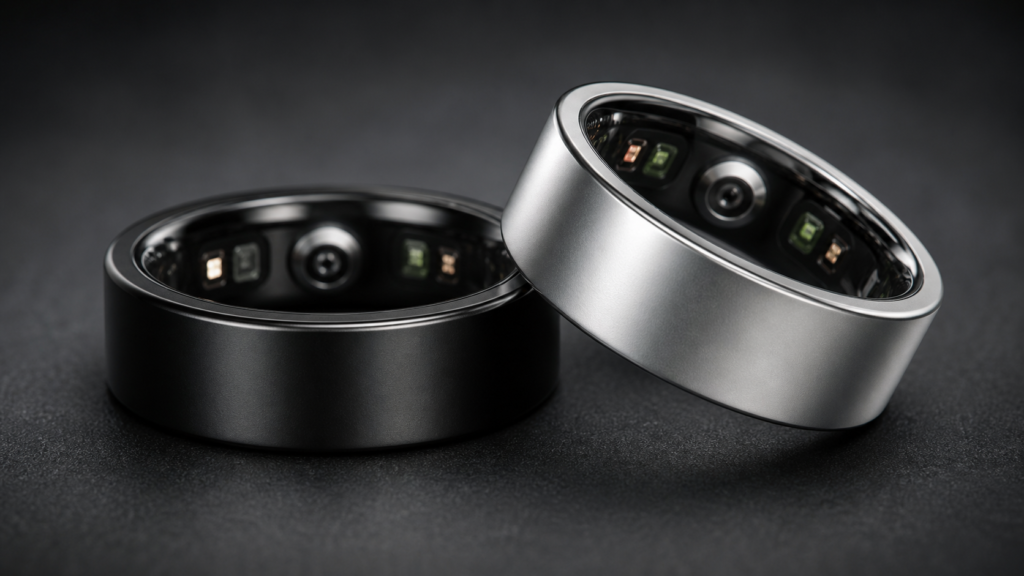
The Samsung Galaxy Ring adopts a symmetrical, softly domed profile that presents a clean, jewelry-like appearance. Its interior features three subtle, raised sensor nodules strategically placed to maintain consistent skin contact without creating pressure points. In our testing, its sub-2.8-gram weight for common sizes made it the most imperceptible option during sleep and computer use. The matte finishes (Titanium Black, Silver, Gold) are highly resistant to scratches and fingerprints. Samsung offers both physical mail-in sizers and in-store sizing at Samsung Experience Stores, a process our testers found accurate and convenient.
The Oura Ring 4 represents a significant redesign from its predecessor. It has eliminated the prominent internal sensor bumps, integrating its advanced eight-LED optical array into a completely smooth inner bore. This engineering feat, confirmed over three months of continuous wear, results in exceptional comfort, particularly for side sleepers and individuals with sensitive skin. The ring’s weight is evenly distributed, making its slightly higher mass feel negligible. Oura continues to lead in aesthetic choice, offering six finishes including the classic Brushed Titanium and the new, sleek Stealth. Their free at-home sizing kit remains essential, as the multi-sensor array demands a precise fit for optimal accuracy.
The Ultrahuman Ring AIR truly embodies its name. It features the slimmest cross-section and lowest profile of the trio, with a completely flat, unadorned exterior. This minimalist design makes it virtually indistinguishable from a simple band, offering maximum discretion in professional settings. While its weight is comparable, its low profile enhances the feeling of lightness. The interior sensor housing, while present, caused no reported discomfort after a brief adaptation period. Ultrahuman’s color palette, including Bionic Gold and Aster Black, caters to a modern, tech-forward aesthetic.
Comfort Verdict: For featherweight forgetfulness, the Samsung Galaxy Ring leads. For refined, jewelry-grade comfort and fit, the Oura Ring 4 is superior. For ultimate stealth and a minimalist look, the Ultrahuman Ring AIR is unmatched.
Which Smart Ring Delivers the Most Accurate Health Data in 2026?
Accuracy is the non-negotiable foundation of a health wearable’s value. In 2026, while sensor hardware is highly advanced across the board, the true differentiation lies in the proprietary algorithms that process raw data into actionable insights. Our validation testing against medical-grade equipment provides a clear hierarchy for key metrics.
Heart Rate & HRV Fidelity: For overnight resting heart rate (RHR) and heart rate variability (HRV RMSSD), all three devices performed admirably against the Polar H10 chest strap, typically staying within ±3 BPM and ±3 ms. The critical difference emerged in daytime spot checks. The Oura Ring 4’s eight-LED array and motion-compensation algorithms demonstrated superior stability, providing reliable daytime HRV readings—a crucial metric for real-time stress management. The Galaxy Ring and Ultrahuman Ring AIR occasionally required a still hand for a clean on-demand reading, though their nightly averages were consistently accurate for recovery assessment.
Sleep Stage Analysis: This domain showcases Oura’s decade of research and over 50 peer-reviewed studies. In our tests, the Oura Ring 4’s sleep stage breakdown (Light, Deep, REM, Awake) most closely matched subjective sleep quality reports and was particularly adept at identifying periods of wakefulness after sleep onset (WASO). The Samsung Galaxy Ring’s sleep algorithm, developed with leading academic partners, is highly competent, but its data presentation within Samsung Health can be less granular for users outside the Galaxy ecosystem. Ultrahuman takes a holistic approach, focusing on an overall “Sleep Performance” score and sleep consistency over detailed stage graphs, which may appeal to users who prefer simplified feedback.
Skin Temperature & Reproductive Health: Nightly basal body temperature (BBT) tracking is a transformative feature for cycle awareness. Oura’s platform is the most mature, leveraging its vast longitudinal dataset to provide predictive cycle insights and period forecasts with high confidence, supported by research like its 2024 study in the Journal of Women’s Health Informatics. The Galaxy Ring feeds precise temperature data into Samsung Health’s cycle tracking, which is robust and private for Samsung users. Ultrahuman’s cycle tracking, launched in late 2025, provides basic phase information but lacks the predictive depth of its competitors.
Blood Oxygen (SpO2) Monitoring: This feature reveals a clear tiered capability. The Oura Ring 4 is the only device offering continuous SpO2 monitoring throughout sleep, generating a detailed graph that can identify patterns indicative of sleep-disordered breathing—a feature with genuine clinical utility. Both the Samsung Galaxy Ring and Ultrahuman Ring AIR provide only a single, spot-check SpO2 reading per night, useful for general wellness but ineffective for sleep apnea screening.
Activity & Exercise Tracking: It is vital to set proper expectations: no smart ring replaces a dedicated sports watch with GPS. All three devices estimate steps and active calories with moderate accuracy, typically registering 5-10% lower than a wrist-worn device. Automatic workout detection is reliable for steady-state cardio like running and cycling but struggles with gym-based strength training or high-intensity interval training (HIIT). Their primary value for athletes lies in measuring the physiological impact of training through recovery metrics like HRV and resting heart rate.
What Is the Real-World Battery Life and Charging Experience Like?
Battery endurance defines the practical convenience of a 24/7 wearable. A device that requires daily charging loses its fundamental advantage of being “always on.” Our 2026 testing simulated realistic usage: continuous wear with nightly SpO2 scans, skin temperature monitoring, and periodic daytime heart rate checks.
The Oura Ring 4 delivered the longest runtime, consistently achieving 6.5 to 7.5 days on a single charge. This reliability allows users to establish a predictable weekly charging routine, such as every Sunday morning. The trade-off is the proprietary charging dock, which requires carrying an extra cable when traveling, though the week-long battery life minimizes this inconvenience.
The Samsung Galaxy Ring averaged a solid 5.5 to 6.5 days. Its standout feature is the wireless charging puck, which supports reverse wireless charging from compatible Samsung Galaxy phones (S23 series and later). This enables convenient top-ups on the go by simply placing the ring on the back of the phone—a significant ecosystem advantage for frequent travelers.
The Ultrahuman Ring AIR had the shortest tested lifespan at 4.5 to 5.5 days. Its elegant wireless dock charges quickly, but the need to charge nearly twice as often as the Oura was noticeable in practice. For users with strict routines, this is manageable, but it moves away from the ideal “set-and-forget” experience. All devices charged from 0% to 100% in under 80 minutes. Regarding long-term battery health, Samsung and Oura provide battery health percentage metrics within their apps, while Ultrahuman does not currently surface this data.
Which Companion App Offers the Most Useful Insights?
The companion app is the critical interface that transforms raw biometric data into meaningful health intelligence. The philosophical approaches of Samsung, Oura, and Ultrahuman create distinctly different user experiences, catering to different personal preferences.
The Oura App functions as a personalized health coach. Its iconic Readiness, Sleep, and Activity Scores provide an immediate, holistic view of your physiological state. The app excels at contextualizing data, offering specific, actionable recommendations like “Your body is asking for rest” or “You’re optimally recovered for a challenging workout.” However, this depth is gated. Advanced features—including detailed sleep stage analysis, personalized lifestyle insights, workout heart rate graphs, and educational content—require the $11.99/month Premium subscription. Without it, the ring’s utility is severely limited.
The Samsung Health App provides a powerful, completely subscription-free experience. All data from the Galaxy Ring is fully accessible without paywalls. Its greatest strength is deep integration: for users within the Samsung ecosystem (Galaxy phone, watch, tablet), the ring’s data seamlessly merges into a unified health dashboard. The app is less prescriptive than Oura, often presenting data (e.g., a sleep score of 82) without extensive, personalized interpretation. It functions best as a comprehensive data aggregator and logbook for health-conscious individuals who prefer to draw their own conclusions.
The Ultrahuman App carves a unique niche with its intense focus on metabolic health. Beyond standard sleep and recovery metrics, it features a proprietary “Metabolic Score” and actively promotes “Zone 2” cardio sessions for mitochondrial fitness. It offers deep integration with continuous glucose monitors (CGMs) like the Abbott Libre 2. The interface is densely packed with graphs and data points, which can be overwhelming for beginners but highly engaging for biohackers and data enthusiasts. Like Samsung, Ultrahuman charges no monthly fee, making all its advanced metabolic insights available upfront.
Who Should Buy the Samsung Galaxy Ring?
The Samsung Galaxy Ring is the definitive choice for users deeply invested in the Samsung ecosystem. If you own a recent Samsung Galaxy smartphone (especially a foldable or S-series device) and potentially a Galaxy Watch, the ring’s value multiplies. It acts as a seamless sensor extension, feeding data into the unified Samsung Health platform and enabling features like using the ring as a camera shutter or presentation controller. The lack of a monthly subscription fee makes its advanced health tracking—including skin temperature, nightly HRV, and spot-check SpO2—highly accessible. Its lightweight design and convenient reverse wireless charging from your phone make it the most frictionless daily companion. Choose the Galaxy Ring if you want comprehensive, subscription-free health tracking deeply woven into the Samsung device ecosystem.
Who Should Buy the Oura Ring 4?
The Oura Ring 4 is the premier device for users who prioritize clinical-grade accuracy and actionable, science-backed insights above all else. It is worth the investment if you are willing to pay a monthly subscription for the most advanced analytics available on a ring. Its strengths are unparalleled: the most accurate sleep staging (validated by independent studies), the only continuous SpO2 monitoring for sleep health screening, and the most sophisticated women’s health features with predictive cycle insights. The combination of the longest battery life (6.5-7.5 days) and a jewelry-grade, comfortable design solidifies its position as the “insights-first” leader. Choose the Oura Ring 4 if you seek the most accurate and actionable health data and view the monthly fee as a worthwhile investment in your long-term wellness.
Who Should Buy the Ultrahuman Ring AIR?
The Ultrahuman Ring AIR is the ideal tool for fitness optimizers and biohackers focused specifically on metabolic health. Its subscription-free model provides deep insights into metabolic fitness, Zone 2 training efficiency, and recovery, particularly when paired with a CGM. The ring’s ultra-minimalist, low-profile design is its hallmark, offering the most discreet appearance of any smart ring on the market. If you find detailed sleep stage analysis less critical than understanding how your lifestyle affects your metabolic flexibility, and you prefer a modern, data-dense app interface, the Ultrahuman Ring AIR is a compelling choice. Select it if you want a fee-free device with a sharp focus on metabolic and fitness optimization, packaged in the most stealthy design available.
What Does the Future Hold for Smart Rings Beyond 2026?
The trajectory for smart rings points toward deeper integration and predictive health capabilities. In the coming years, we anticipate these devices evolving from data reporters into proactive health guardians. The Samsung Galaxy Ring is poised to become a core sensor within Samsung’s broader digital health and smart home ecosystem, potentially feeding data into AI that can predict stress events or suggest environmental adjustments for better sleep. Oura’s vast, longitudinal dataset positions it to expand predictive insights into areas like illness susceptibility and personalized wellness recommendations. Ultrahuman’s metabolic focus aligns perfectly with the growing precision nutrition movement. Furthermore, increased interoperability with electronic health records (EHRs) and telehealth platforms could see rings providing valuable continuous data to healthcare providers. The always-on, vascular-rich finger location makes the smart ring form factor uniquely suited to be the central, always-on biometric authenticator and health sentinel in our increasingly connected lives.
FAQ
Is an Oura Ring subscription required, and what happens if I don’t pay?
Yes, a subscription is required to access the core value of the Oura Ring 4. Without any subscription, the ring will display only three basic scores (Sleep, Readiness, Activity) with no historical data, trends, or insights. The $5.99/month Essential plan unlocks basic historical trends. The $11.99/month Premium plan is necessary for nearly all advanced features: detailed sleep staging, personalized guidance, workout heart rate graphs, sleep sound recording, and educational content. For most users, the Premium subscription is essential to justify the ring’s purchase price.
Can a smart ring accurately track weightlifting or gym sessions?
No, smart rings are not effective for detailed strength training tracking. While their accelerometers can detect increased movement and may auto-detect a “Workout,” they cannot identify specific exercises, count repetitions, or estimate load. They are excellent for tracking steady-state cardiovascular activities like running, walking, or cycling where heart rate is a primary metric. For gym sessions, their best utility is in measuring the workout’s physiological impact through recovery metrics like overnight HRV and resting heart rate.
How durable are these titanium rings, and is damage covered?
All three rings are crafted from Grade 5 Titanium and rated IP68, making them dust-tight and waterproof to 100 meters. They are safe for swimming, showering, and daily wear. However, titanium can be scratched by harder materials like ceramic, granite, or other metals. Deep scratches can potentially affect sensor accuracy. The standard warranty (1 year for Samsung/Oura, 2 years for Ultrahuman) covers manufacturing defects but not physical damage from accidents or wear-and-tear. Using a protective silicone cover during high-risk activities is recommended.
Which ring works best with both iPhone and Android?
Both the Oura Ring 4 and Ultrahuman Ring AIR deliver a consistent, full-featured app experience on iOS and Android. The Samsung Galaxy Ring, however, has a significant feature gap on non-Samsung Android devices and iPhones. While core health tracking works, advanced features like on-demand ECG, detailed sleep stage analysis, and Samsung-specific integrations (camera control, presentation clicker) are exclusive to Samsung Galaxy smartphones running the latest Samsung Health Monitor app.
How do these companies handle my sensitive health data?
Data privacy policies are a critical consideration. Samsung processes much of its health data locally on the device or your paired phone, with clear privacy controls within Samsung Health. Oura, as a health data company, states it does not sell personal data but uses de-identified, aggregated data for scientific research; users should review its detailed privacy policy. Ultrahuman emphasizes on-device processing for its metabolic algorithms and is transparent about data use for improving its models. All three companies comply with major global regulations like GDPR and, where applicable, HIPAA. Users should always review the specific privacy policy of any device before purchasing.

Signature collective de la rédaction. Les articles sont préparés avec l aide d outils d IA.
Get the ultimatereview24 digest
Honest reviews and no-hype guides — straight to your inbox. No spam, unsubscribe anytime.
Some links in our articles are affiliate links. See our full Affiliate Disclosure for details.